

I figured that for the very first post on this blog, I should start at the very beginning (which is “a very good place to start” 😉). Or at least with something that I am planning to reference in many of the upcoming posts about story structure. And that is my basic story arc:
Why Another Story Arc?
Why another story arc, you ask? There are gazillions of them out there after all (many of them very helpful and some of them much more detailed than this one, such as Joseph Campbell’s infamous Hero’s Journey). And why my story arc and what makes it special? I’m so glad you asked!
Well, the short answer is that I will be referring to what I call “my story arc” quite a bit as I write forthcoming posts. Therefore, so we can all be on the same page and so I don’t have to be constantly explaining the context of what I’m referring to, I figured I’d start by presenting the basic story arc I will be referring to often (and then I can even hyperlink back to this post regularly – amazing 😍)
The longer, more hefty answer is for the following three reasons:
- I find many other story arc diagrams to either be too basic to actually be useful (Woah, no way, the story needs a beginning, middle and end!) or too detailed to be generally applicable (for example, I don’t think it’s helpful to think through the entire hero’s journey every time you write a picture book). You will notice that mine is relatively basic (it can be applied to nearly every storytelling medium, short or long) but also has some key additional elements than something simply like “beginning → rising action → climax → falling action → ending”. That is a good foundation, but I want something which can actually aid the storyteller (like me) in figuring out what those sections should include to craft a particularly compelling and impactful story arc – but still be broad enough that they can apply to any genre or medium!
- “My story arc” could actually be called more of a protagonist/character arc, not simply a plot arc. I find it an extremely helpful tool for structuring character-driven stories (which I find to be the most engaging stories generally, and essential for some of the storytelling mediums I personally love in particular, such as musical theater or lots of children’s media). When I say “story” and particularly “story arc”, I am often referring to the individual stories of multiple characters, not the plot in general. As a matter of fact, I think individual characters’ stories are what make a good plot – ultimately if you can figure out which “character(s)” is really driving the action forward in your story (even if said character is inanimate or unembodied), then you can write a much more compelling plot! There are forms of storytelling that rely more on the plot or circumstances as the primary story engine rather than character (in other words it focuses on WHAT, not WHO), but the intent of this site is to focus particularly on character-driven storytelling, where the various story arcs of the characters come together and interact to create the plot. Thus the introduction of a basic character-focused “story arc” as a foundation for this site.
- This truly is “my” story arc, even though it may appear or contain some elements similar to others you have seen. That is to say, a few years ago I sat down with various “texts” (I use “texts” in the media studies sense of the term, meaning books, movies, tv episodes, children’s books, etc. – a single instance of a medium which can be studied) which I considered to be high-quality storytelling, and plotted the story arcs of each of their protagonists (more on the meaning of what a “protagonist” truly is coming in a future post!) I then looked for patterns that emerged in all or most of these arcs and synthesized them into the following basic story arc:
The Schwartz Story Arc diagram
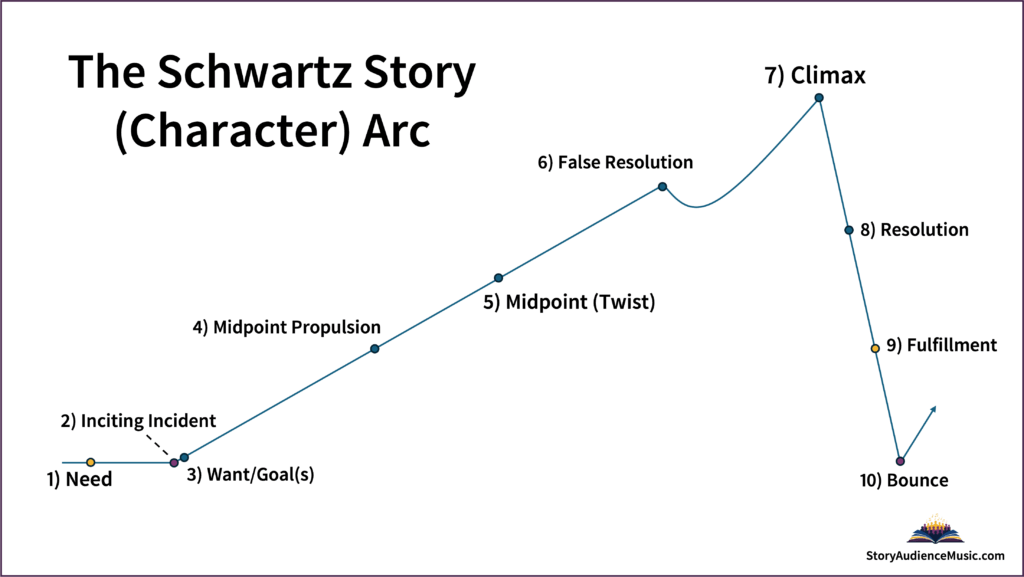
You’ll notice a few distinct parts such as the False Resolution (as far as I know, one of the most unique parts of my chart) and the Need vs. Want vs. Goal(s) (and their accompanying resolutions or lack thereof). Notice how the gold number 1) Need connects to number 9) Fulfillment, while number 3) Want connections to number 8) Resolution. You can absolutely have a positive Resolution with a negative/tragic Fulfillment, vice versa, a double positive, or a double negative! This will be discussed in much more detail in the next several posts.
I should also mention that the x-axis represents runtime (usually relatively to scale with the story’s content (page count, runtime, etc.), though the post-Climax elements are sometimes pretty quick in shorter story mediums and there can be some fluidity, especially in the central elements). The y-axis represents what I would call “story tension/energy” (which is important to clarify, since different story arcs I have seen have various things implied for the y-axis).
Thus, we start with a Need, the Inciting Incident propels us from a place of relative calm story energy/status quo into our arc (usually creating a Want and some Goals to get that Want) which arc slowly builds in energy (and can have additional little ups and down but generally follows this basic arc), seems to be settling more for the False Resolution (which can be positive or negative), but then spikes back up dramatically into the Climax, and then deescalates in energy with either positive or negative (tragic) Resolution and Fulfillment (before our final little Bounce:).
A quick note about the examples I will use in this blog:
You will notice I will frequently (and unapologetically) use children’s media as texts to examine story structure on this website (children’s books, children’s TV episodes, etc). I also will stick with relatively “family friendly” examples in the content I use to illustrate my points. This is for two very good reasons:
- I personally love and have a passion for children’s media! It is one of my personal favorite mediums to consume, and so one I am very familiar with. I literally studied it as part of my degree and have done extensive research on it for years prior to getting a degree and since. (I also personally love “family friendly” content, even if it’s not specifically “children’s”).
- I find that children’s media makes particularly good case studies for looking at and identifying storytelling principles because the medium is so brief and concentrated. And lest you be fooled, the highest-quality children’s media is not lacking one whit in its storytelling robustness! Basically, I find it easier to see and teach from children’s media, because there is less “fluff” to cut through to get to the bones!
You will also notice that I often use musical theater examples, because that happens to be one of my other personal favorite mediums (which in contrast happens to be one of the longest and most complex storytelling mediums:).
This blog will also cover audience building and branding (which I have also studied extensively in my degree and elsewhere) as well as at some point music, as I find those two elements to be particularly interwoven with some of my favorite mediums of good storytelling! But those will be coming further down the road…
In the next few posts, we’ll discuss each of the ten (10) elements of the Schwartz Story Arc in more detail and look at plenty of examples! So in the words of Santa from The Year without a Santa Claus: “There’s no time to waste – Tonight we ride!”